

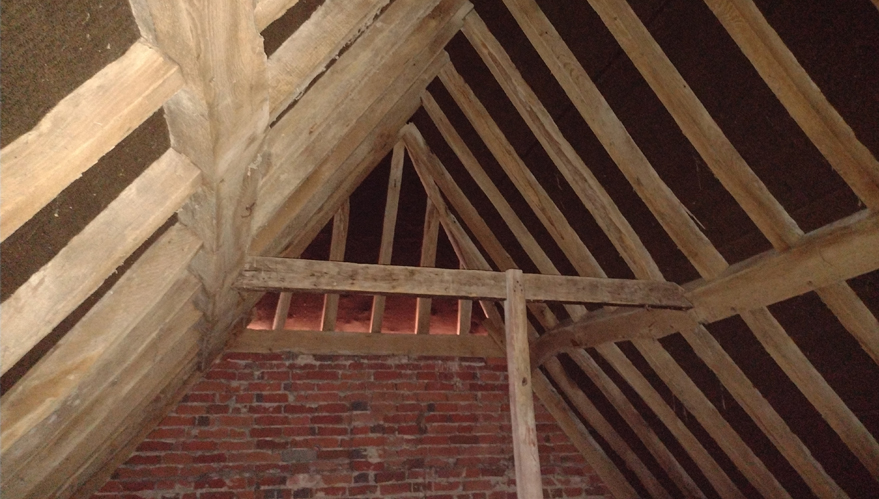
The project began in March 2021, when a significant quantity of bat droppings was discovered in the roof space of a 15th-century cottage in Upham. The droppings varied in age, confirming long-term use of the roost.
Samples were collected and sent for DNA analysis, which confirmed the presence of Serotine bats (Eptesicus serotinus), Common Pipistrelles (Pipistrellus pipistrellus), and Brown Long-eared bats (Plecotus auritus).
Serotine’s are one of Britain’s largest bat species and usually one of the first to appear in the evening, often emerging in good light.
An emergence survey undertaken in July 2021 recorded 35 Serotine bats, one common Pipistrelle and one brown long-eared bat emerging from the property. Due to the number of bats recorded it the building was identified as supporting a Serotine maternity roost and common Pipistrelle and brown long-eared day roosts. In 2022, this number peaked at 71 Serotine bats—making it the largest known roost of this species in Hampshire, and therefore of regional importance.
Alex Hannam observed: “As you open the loft hatch, you could hear social chatter, indicating a large and active roost was present.”
The initial development proposal posed a high potential impact to the roost. However, through positive engagement with the client, we identified a solution that balanced the ecological importance of the site with the homeowner’s goals. A mitigation strategy was agreed to minimise disturbance to the bats while allowing development to proceed.
Following the granting of planning consent, a mitigation licence was obtained from Natural England, and Pro Vision implemented the licensed mitigation measures.
Mitigation and Development Strategy
A phased approach was adopted, allowing part of the building to be carefully demolished in Spring 2023 and enabling Foxray Limited to continue ground works and building up to the eaves through the summer, whilst avoiding disruption to the maternity roost.
In Autumn 2023, we supervised tile removal where the new roof would be tied into the existing structure. This ensured that any bats encountered during the work could be safely captured and relocated to pre-installed bat boxes on site.
The licence allowed for minor modifications to the roost, including a slight reduction in available space, which was offset by replacement roosting features in the new extension. As well as retaining the majority of the original roost, the homeowners provided additional roosting space of equal size for roosting bats, providing further enhancement to the site.
Post-Development Monitoring
Two years after completion, we conducted a follow-up monitoring survey, including an updated internal inspection and emergence survey.
During this monitoring, we recorded that all mitigation had been installed successfully and that bats continued to use the roost. During the internal inspection pups were recorded which confirmed that successful breeding had occurred on site that year. The client also confirmed that bats continued to breed on site in 2023 and 2024. During the subsequent emergence survey approximately recorded 40 Serotine bats were recorded emerging, assuming the pups were still too young to fly this would mean the roost was a similar size to the roost pre-works.
These results confirm that the impact of development was successfully mitigated, and the bats have continued to breed at the site. Therefore, we have maintained the favourable conservation status of the species.
Monitoring will continue as required under the licence, with surveys scheduled through to 2031.
Alex Hannam concluded:
“It’s been a privilege to work with the homeowner to deliver a scheme which not only protects this regionally important roost, but also allowed them to create the beautiful family home they now live in.”


